Understanding protection against digital threats and unauthorised access
Cyber security protects computers, networks and data from unauthorised access and attacks. It involves network security, identity management, data protection, application security and incident response.
Why cutting defined-benefit pensions by 40% would create major problems
Cutting defined-benefit pensions by 40% to match defined-contribution outcomes would impose substantial losses on existing pensioners, raise legal questions about retrospective benefit cuts, and push some into means-tested benefits.
How do we protect ourselves against malign foreign manufacturers, beit hardware or software?
Hardware and software from any country can pose security risks. Protection requires updating devices, restricting access, assessing manufacturers, and for governments, supply-chain controls and independent testing.
Cyber security involves making attacks harder, limiting damage if they succeed, and enabling recovery. This guide covers personal computers, websites and businesses, with practical controls for each.
Ransomware attack: from first compromise to discovery
Ransomware attacks typically develop over weeks, with attackers gaining access long before files are encrypted. Understanding the stages helps organisations identify and stop attacks earlier.
Cyber attacks typically unfold in stages from reconnaissance to achieving objectives. Real examples show how criminals exploit trust, weak access controls and software vulnerabilities rather than sophisticated technical skills.
The Office for Budget Responsibility's long-term pension forecast depends on assumptions that deserve closer scrutiny.
The OBR's projections suggest public-service pension costs will fall relative to GDP, but this relies on specific assumptions about wage growth, employment and economic performance that warrant stress-testing.
How would cuts to future public-sector pension accrual affect government spending over time?
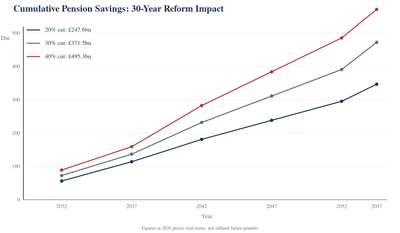
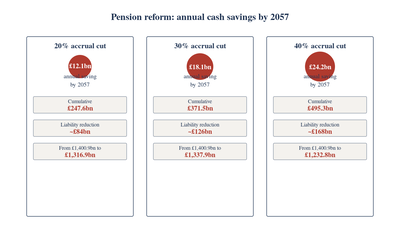
Analysis of how reducing future pension accrual by 20-40% would cut annual government spending on unfunded public-sector pensions, with cumulative savings reaching £495bn by 2057 in today's money.
How a 30-year pension reform starting in 2027 could reduce Britain's unfunded public-sector liability
Modelling shows reducing future pension accrual by 20-40% from 2027 could save £84bn to £168bn in today's money, though cash savings build gradually and depend on workforce age distribution.
Three different effects on pensions: immediate accounting impact, long-term liability and actual cash spending
Public pension reforms affect government finances in three distinct ways: accounting costs, liability reduction and cash payments. These operate on different timescales and have different magnitudes.
Understanding the difference between cutting existing pensions and reducing future accrual
Cutting existing pensions would save cash immediately but affect current pensioners. Reducing future accrual saves little now but substantially lowers long-term liability as pensioners gradually transition to less generous schemes.
Calculating the real Treasury saving from reducing defined-benefit pension payments
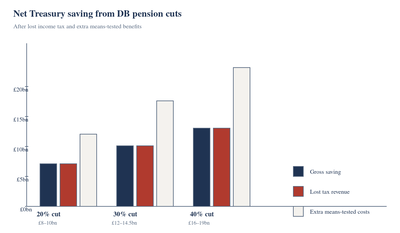
A 40% cut to unfunded public-sector pensions would save £16-19bn annually after accounting for lost tax revenue and increased welfare spending, not the £24bn often claimed.
Bringing DB pensions in line with DC pensions requires realistic analysis, not a blanket percentage cut
A government proposal to cut defined benefit pensions by 40% lacks sound comparison with defined contribution pensions, which offer less certainty and different risk profiles.
Estimated Treasury saving from a 40% cut in DB pensions
A 40% reduction in public-sector defined-benefit pensions could save around £19-21 billion annually after accounting for lost income tax, though actual savings would depend on means-tested support and legal challenges.
Roughly 40-50 countries experience armed conflict in 2025-2026.
There are armed conflicts in around 40-50 countries worldwide, depending on how a conflict is defined. The latest major studies provide these figures: 40 armed conflicts across the world, according to the School for a Culture of Peace at the Autonomous University of Barcelona.
Address benefits system costs, increasing productivity, developing engineering and technical carears through education realistic pay structures.
Britain could rebuild manufacturing by reducing industrial energy costs, improving education and skills training, making investment attractive, and connecting employment support to real vacancies.
NFTs, crypto mixers and decentralised finance platforms enable money laundering through subjective valuations, transaction obscuring and regulatory gaps that traditional systems lack.
Criminals use mixers, DeFi protocols and NFT flipping to disguise stolen cryptocurrency as legitimate gains, but law enforcement increasingly tracks them through blockchain analysis and heuristic tagging.
The tools, techniques and partnerships governments and exchanges use to trace crypto money laundering, even when disguised with mixers, NFTs or DeFi
Governments use blockchain analysis tools, exchange monitoring and legal enforcement to track crypto laundering, targeting wallets, mixers and off-ramps where criminals convert digital assets to cash.
Cryptocurrencies are decentralised digital currencies secured by cryptography and recorded on blockchain. They operate without central authorities and enable peer-to-peer transactions globally.
Bitcoin is a peer-to-peer digital currency created in 2009. It uses blockchain technology, mining to validate transactions, and a decentralised network of computers instead of banks.
AI could produce enormous benefits, but society and governments are not preparing adequately for the disruption.
Bill Gates argues AI will transform employment, healthcare and education, but warns governments lag behind in preparing for job displacement, social isolation and loss of critical thinking skills.
Countries fund and organise long-term care differently: some rely on public services, others on family support or insurance. The approach affects who pays, what services exist, and whether older people can afford care.
Care assistants in England earn around £12.71-£14 per hour, close to the National Living Wage. Pay differs little for experienced workers, raising questions about staff retention and continuity of care.
Care homes cost around £67,600 yearly per resident. Staffing accounts for 60% of expenses, with additional costs for buildings, food and utilities. Profitability varies widely.
Many older people in England experience loneliness and unmet care needs, but support services often fail to reach them. Services exist but gaps in eligibility, cost and accessibility leave vulnerable pensioners isolated.
Science has not established whether consciousness survives death. The Hadron Collider's discoveries about matter and energy do not provide evidence of an afterlife, though they deepen our understanding of the physical world.
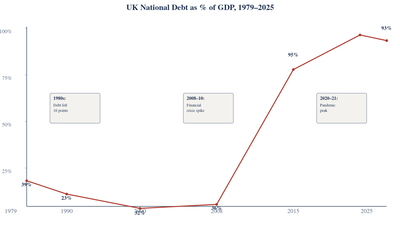
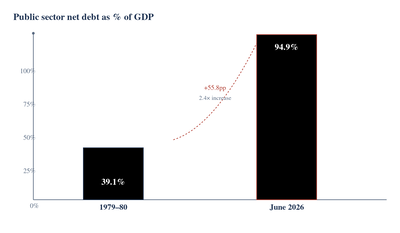
How the UK's national debt as a percentage of GDP has changed since 1979
UK national debt fell sharply in the 1980s, rose in the early 1990s and after 2008's financial crisis, and spiked during the pandemic before falling slightly.
UK national debt has risen from 39% of GDP in 1979 to 95% in 2026, driven by recessions, the financial crisis, the pandemic and ongoing spending deficits.
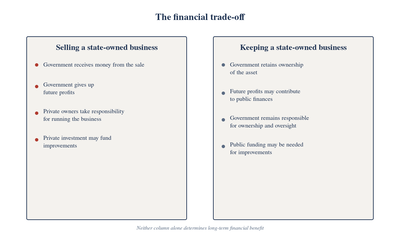
The government sold state-owned businesses to raise revenue and reduce state involvement in industry. Whilst privatisation brought substantial one-off money, the relationship between these sales and national debt reduction was more complex than a simple transaction.
We pay water companies to deliver and take away water. The latter costs more, why? What are 'surface water' charges.
Wastewater treatment costs far more than water supply because it involves extensive infrastructure for collection, treatment, sludge disposal and environmental compliance. Surface-water and highway drainage charges cover rainwater management.
Following illicit funds from a ransomware payment to a clean bank account
Criminals convert illicit funds to crypto, use mixers and privacy coins to obscure the trail, then layer transactions through NFTs and decentralised finance platforms before cashing out as clean money.
How wallets, mixers and decentralised exchanges changed the movement of illicit wealth
Criminals use crypto mixers, NFTs, decentralised finance platforms and privacy coins to hide the origin of stolen or illicit money, exploiting gaps in global regulation and enforcement.