Why cutting defined-benefit pensions by 40% would create major problems
Cutting defined-benefit pensions by 40% to match defined-contribution outcomes would impose substantial losses on existing pensioners, raise legal questions about retrospective benefit cuts, and push some into means-tested benefits.
The Office for Budget Responsibility's long-term pension forecast depends on assumptions that deserve closer scrutiny.
The OBR's projections suggest public-service pension costs will fall relative to GDP, but this relies on specific assumptions about wage growth, employment and economic performance that warrant stress-testing.
How would cuts to future public-sector pension accrual affect government spending over time?
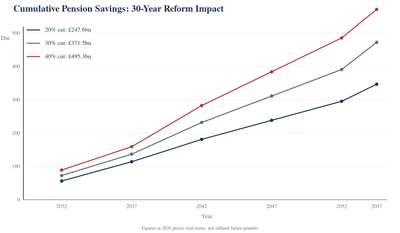
Analysis of how reducing future pension accrual by 20-40% would cut annual government spending on unfunded public-sector pensions, with cumulative savings reaching £495bn by 2057 in today's money.
How a 30-year pension reform starting in 2027 could reduce Britain's unfunded public-sector liability
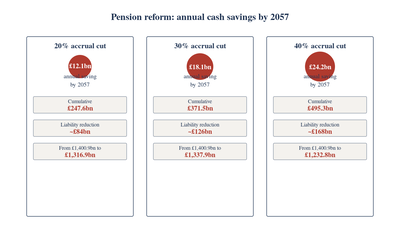
Modelling shows reducing future pension accrual by 20-40% from 2027 could save £84bn to £168bn in today's money, though cash savings build gradually and depend on workforce age distribution.
Three different effects on pensions: immediate accounting impact, long-term liability and actual cash spending
Public pension reforms affect government finances in three distinct ways: accounting costs, liability reduction and cash payments. These operate on different timescales and have different magnitudes.
Understanding the difference between cutting existing pensions and reducing future accrual
Cutting existing pensions would save cash immediately but affect current pensioners. Reducing future accrual saves little now but substantially lowers long-term liability as pensioners gradually transition to less generous schemes.
Calculating the real Treasury saving from reducing defined-benefit pension payments
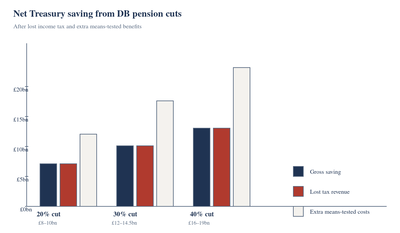
A 40% cut to unfunded public-sector pensions would save £16-19bn annually after accounting for lost tax revenue and increased welfare spending, not the £24bn often claimed.
Bringing DB pensions in line with DC pensions requires realistic analysis, not a blanket percentage cut
A government proposal to cut defined benefit pensions by 40% lacks sound comparison with defined contribution pensions, which offer less certainty and different risk profiles.
Estimated Treasury saving from a 40% cut in DB pensions
A 40% reduction in public-sector defined-benefit pensions could save around £19-21 billion annually after accounting for lost income tax, though actual savings would depend on means-tested support and legal challenges.
NFTs, crypto mixers and decentralised finance platforms enable money laundering through subjective valuations, transaction obscuring and regulatory gaps that traditional systems lack.
Criminals use mixers, DeFi protocols and NFT flipping to disguise stolen cryptocurrency as legitimate gains, but law enforcement increasingly tracks them through blockchain analysis and heuristic tagging.
The tools, techniques and partnerships governments and exchanges use to trace crypto money laundering, even when disguised with mixers, NFTs or DeFi
Governments use blockchain analysis tools, exchange monitoring and legal enforcement to track crypto laundering, targeting wallets, mixers and off-ramps where criminals convert digital assets to cash.
Cryptocurrencies are decentralised digital currencies secured by cryptography and recorded on blockchain. They operate without central authorities and enable peer-to-peer transactions globally.
Bitcoin is a peer-to-peer digital currency created in 2009. It uses blockchain technology, mining to validate transactions, and a decentralised network of computers instead of banks.
We pay water companies to deliver and take away water. The latter costs more, why? What are 'surface water' charges.
Wastewater treatment costs far more than water supply because it involves extensive infrastructure for collection, treatment, sludge disposal and environmental compliance. Surface-water and highway drainage charges cover rainwater management.
Following illicit funds from a ransomware payment to a clean bank account
Criminals convert illicit funds to crypto, use mixers and privacy coins to obscure the trail, then layer transactions through NFTs and decentralised finance platforms before cashing out as clean money.
How wallets, mixers and decentralised exchanges changed the movement of illicit wealth
Criminals use crypto mixers, NFTs, decentralised finance platforms and privacy coins to hide the origin of stolen or illicit money, exploiting gaps in global regulation and enforcement.
Did Macquarie's ownership of Thames Water prioritise shareholder returns over long-term sustainability?
Macquarie owned Thames Water from 2006 to 2017, investing £11 billion in infrastructure while increasing debt to £11 billion and paying £879 million in dividends, sparking debate over priorities.
Treasury micromanagement is partly responsible for poor privatised utilities, but systemic failures run deeper
Treasury short-termism, weak regulation, privatisation without oversight, and foreign ownership prioritising dividends have combined to underinvest in water and rail infrastructure.
The methods and tools used by Equatorial Guinea's vice-president to hide and protect illicitly obtained assets
Teodorin Obiang used shell companies, luxury real estate, art, yachts and cars to launder tens of millions in stolen state wealth, with help from banks and lawyers across multiple countries.
How one man stole his country's wealth and turned it into luxury goods
How Equatorial Guinea's Vice President stole state funds through inflated contracts, laundered money via offshore shell companies, and spent it on mansions, yachts and art before authorities seized his assets.
How stolen money is laundered through shell companies, offshore accounts and luxury assets
Money laundering converts illicit wealth into seemingly legitimate assets through placement, layering and integration stages, using shell companies, offshore accounts and luxury purchases.
How stolen wealth moves through tax havens and financial centres, and what it costs ordinary people
Kleptocrats move embezzled money through shell companies and secrecy jurisdictions, inflating property prices globally and starving public services in their home countries.
Real-world cases of stolen state wealth and international responses to kleptocrats hiding assets abroad
Major cases involving Russian oligarchs, Malaysia's 1MDB scandal, Nigerian and Equatorial Guinean officials, and Uzbek elites show how kleptocrats hide billions. Countries now use sanctions, asset freezes, transparency registers and unexplained wealth orders to fight back.
A guide to governments where leaders steal national resources for personal gain
A kleptocracy is a government where officials and elites use power to steal national resources. The article lists current and historical examples, from Russia to North Korea, and notes signs of kleptocratic corruption worldwide.
Comparing defined benefit and defined contribution pensions: which provides better retirement income?
Defined benefit pensions offer guaranteed income but are rare outside the public sector. Defined contribution pensions require workers to manage investment risk, but aggressive investing and delayed retirement can match DB outcomes.
Understanding the UK's two-tier pension system: Defined Benefit versus Defined Contribution
The UK pension system splits between Defined Benefit pensions, offering guaranteed income mostly to public sector workers, and Defined Contribution pensions, where private sector workers bear investment risk.
BlackRock's Aladdin platform: how it manages trillions in global assets
Aladdin is BlackRock's proprietary financial platform used to manage investment portfolios, assess risk, and inform decisions on over $21 trillion in assets globally.
How wealth and financial power shape politics, economies and societies
Money doesn't literally control everything, but wealthy individuals, corporations and financial institutions exert substantial influence over government policy, economics, media and global decision-making.
How much power does the world's largest asset manager really have?
BlackRock is the world's largest asset manager with $9 trillion in assets, giving it significant influence over corporate governance and financial markets, though it does not control governments or societies.
The complex relationship between big business and government, and its implications for policy, democracy and society
Big businesses influence government through lobbying, campaign financing and regulatory capture, affecting policy, democracy and public services. This can drive growth but may also undermine democratic processes and prioritise corporate profits over public welfare.
How large corporations' global influence affects economies, democracy and daily life
Large corporations can drive growth and innovation, but also concentrate wealth, weaken regulation, harm environments, and undermine democracy through lobbying and market dominance.