How the UK's national debt as a percentage of GDP has changed since 1979
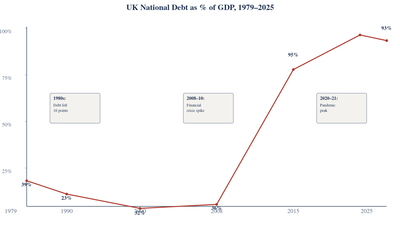
UK national debt fell sharply in the 1980s, rose in the early 1990s and after 2008's financial crisis, and spiked during the pandemic before falling slightly.
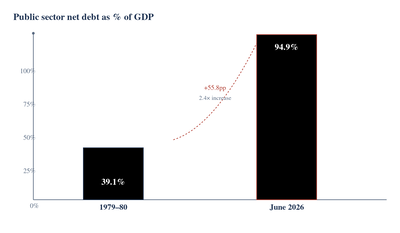
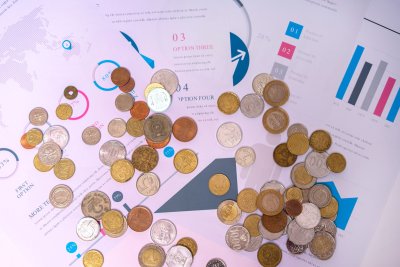
UK national debt has risen from 39% of GDP in 1979 to 95% in 2026, driven by recessions, the financial crisis, the pandemic and ongoing spending deficits.
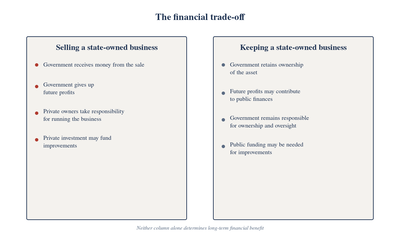
The government sold state-owned businesses to raise revenue and reduce state involvement in industry. Whilst privatisation brought substantial one-off money, the relationship between these sales and national debt reduction was more complex than a simple transaction.
What the statistics show about foreign nationals in UK custody and their deportation status
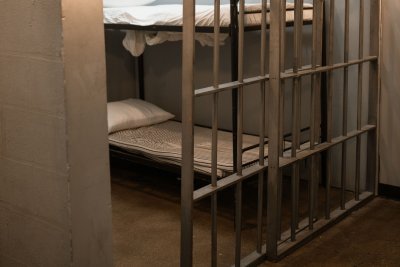
On 31 March 2026, 10,487 foreign nationals were in UK custody, representing 12% of the prison population. Most were from Albania, Ireland, Poland, Romania and India.
Why aren't IPP prisoners automatically compensated for years served beyond their tariff?
IPP prisoners detained beyond their tariff are not automatically entitled to compensation unless specific legal breaches occurred, such as unlawful delay or defective sentences subsequently quashed.
How a flawed sentencing system created indefinite imprisonment, why it was abolished in 2012, and why nearly 900 people remain in prison under it today
IPP sentences, introduced in 2005, allowed indefinite imprisonment based on dangerousness. Parliament abolished the system in 2012 but left existing sentences intact. Nearly 900 people remain imprisoned, some decades beyond their original tariff.
The indefinite jail sentences that Parliament abolished but left thousands still serving
IPP sentences, introduced in 2005 for dangerous offenders, were abolished in 2012 but not retroactively. Nearly 3,000 people remain imprisoned under them, often decades beyond their original tariff.
Why do UK governments often defer important policies to the next parliamentary term?
Governments delay major reforms for electoral strategy, legislative complexity, budget planning and to avoid immediate political backlash, whilst signalling long-term intent.
How a British Airways flight became caught in Iraq's invasion of Kuwait, and why survivors say the government knew in advance
A British Airways flight landed in Kuwait during Iraq's 1990 invasion. All 385 people were detained for 126 days. Survivors now allege the UK government and BA knew beforehand and allowed the flight to land, possibly to insert special forces operatives.
Controversial European Court of Human Rights rulings and debates over judicial overreach
Five high-profile ECHR rulings have sparked accusations of judicial activism and bias, raising questions about whether the court imposes progressive values on member states or protects fundamental rights.
Examining claims of corruption at Europe's human rights court
The European Court of Human Rights faces criticism over political influence and judicial activism, but has no credible evidence of systematic corruption, bribery or fraud.
Criminal convictions against civil servants do happen, but remain relatively uncommon due to internal processes and legal protections
Civil servants can face criminal charges, but prosecutions are rare because misconduct is often handled internally, intent is difficult to prove, and political considerations sometimes intervene.
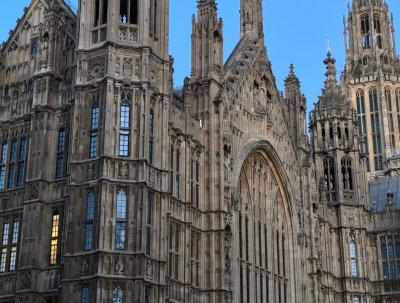
Is the House of Lords value for money? Weighing its cost against its scrutiny role and democratic legitimacy.
The House of Lords costs £120 million yearly and has over 800 members. Supporters cite its expertise and legislative review; critics question its cost, unelected nature, and efficiency.
How poor planning and weak oversight have cost taxpayers over £300 billion on failed projects
A comprehensive examination of major government spending failures across the NHS, defence, infrastructure and welfare, identifying systemic issues in procurement, project management and accountability.
Should prisoners be required to work to pay for their food and accommodation?
Requiring prisoners to work to cover incarceration costs raises legal, ethical and practical concerns, including potential labour exploitation, double punishment, and undermining rehabilitation goals.
What is the total cost of MPs and civil servants in the UK?
MPs and their support staff cost around £500-600 million annually. Civil servants supporting government cost £15-17 billion yearly, though costs directly attributed to MPs alone are difficult to isolate precisely.
How the European Court of Human Rights reports to the Council of Europe
The ECHR operates independently on judicial matters but reports to the Council of Europe's Committee of Ministers, which supervises whether member states comply with the Court's judgments.
Could housing summary offenders on barges like the Bibby Stockholm help solve prison overcrowding?
Barges could temporarily relieve prison overcrowding and reduce costs, but raise concerns about living standards, mental health, security, and community opposition. Permanent solutions require broader criminal justice reform.
An overview of the UK's leading independent economic research institute and its work on taxation, spending and inequality
The IFS is an independent UK think tank established in 1969, researching taxation, public spending, inequality and labour markets to inform policymaking with evidence-based analysis.
How does the OBR provide independent analysis of the UK's public finances?
The OBR is an independent body established in 2010 to forecast the economy and public finances, evaluate government fiscal policy, and enhance transparency in the UK's economic decision-making.
What procedures should a civil servant follow when they discover an issue within government?
Civil servants can report problems through internal line managers, departmental whistleblowing officers, external agencies like the NAO, or parliamentary committees. The Public Interest Disclosure Act protects them from retaliation.
Governmental preferred supplier programmes offer cost savings and efficiency, but risk reducing competition and fostering corruption
Government preferred supplier programmes cut costs and streamline procurement but risk reducing competition, encouraging corruption, and limiting innovation. Transparency and regular reviews help balance these trade-offs.
Would sending summary offenders to a British-run prison in Rwanda solve our prison dilemma?
Relocating summary offenders to a British-run Rwandan prison could ease overcrowding and reduce costs, but raises legal, ethical and logistical challenges requiring careful consideration.
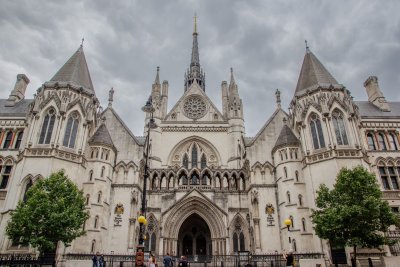
Types of criminal offence and which courts handle them
UK criminal offences are classified by severity into summary offences, indictable offences and either-way offences, each tried in different courts with varying penalties.
Could serious offenders serve prison time abroad? The legal, ethical and practical challenges explained.
Sending UK prisoners to Rwanda raises complex legal, human rights, logistical and diplomatic questions. It would require new treaties, safeguards against poor conditions, secure transport systems and careful diplomatic handling.
Notable examples of government misleading the public in the UK
A comprehensive overview of thirty instances where the UK government has been accused of misleading the public, ranging from the Iraq War and Hillsborough to Brexit, the Windrush scandal and NHS funding.
Examples foreign governments misleading the public
Governments have historically misled the public in various ways, often for political gain, to maintain public order, or to advance specific agendas. Here are some notable examples from different countries and contexts:
Governments mislead the public through propaganda, censorship, data manipulation, framing and scapegoating. Critical thinking and independent media help counter these tactics.
Governments balance economic considerations with political, social, cultural, ideological, security, environmental and technological factors when making policy decisions.
Understanding the key responsibilities governments have in modern society
Governments maintain law and order, provide public services like healthcare and education, manage economies, ensure social welfare, protect national security, conduct foreign policy, protect the environment, and promote justice and equality.
Why goods from preferred suppliers often cost more than retail prices
Preferred suppliers charge more due to stricter quality standards, customization, technical support, reliable delivery, compliance certification, and comprehensive after-sales services that retail options typically don't provide.
How power, pressure and privilege can erode ethical standards among the elite and politicians
Explores how individuals in positions of power often shift from idealism to corruption through power dynamics, lack of accountability, financial incentives, and institutional vulnerabilities.
When can criminal prosecutions be brought against the elite?
Politicians and the wealthy can be prosecuted for corruption, fraud, obstruction of justice, human rights abuses, environmental crimes, terrorism and other offences, though prosecution depends on evidence, prosecutorial discretion and political will.