Why cutting defined-benefit pensions by 40% would create major problems
Cutting defined-benefit pensions by 40% to match defined-contribution outcomes would impose substantial losses on existing pensioners, raise legal questions about retrospective benefit cuts, and push some into means-tested benefits.
The Office for Budget Responsibility's long-term pension forecast depends on assumptions that deserve closer scrutiny.
The OBR's projections suggest public-service pension costs will fall relative to GDP, but this relies on specific assumptions about wage growth, employment and economic performance that warrant stress-testing.
How would cuts to future public-sector pension accrual affect government spending over time?
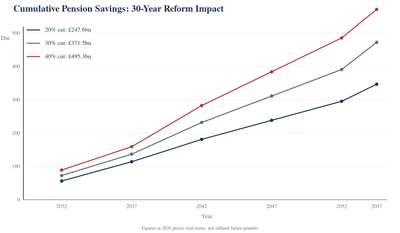
Analysis of how reducing future pension accrual by 20-40% would cut annual government spending on unfunded public-sector pensions, with cumulative savings reaching £495bn by 2057 in today's money.
How a 30-year pension reform starting in 2027 could reduce Britain's unfunded public-sector liability
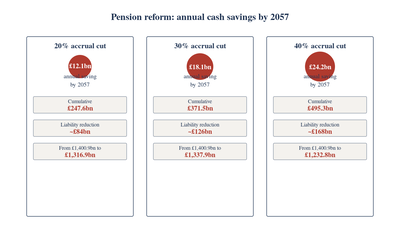
Modelling shows reducing future pension accrual by 20-40% from 2027 could save £84bn to £168bn in today's money, though cash savings build gradually and depend on workforce age distribution.
Three different effects on pensions: immediate accounting impact, long-term liability and actual cash spending
Public pension reforms affect government finances in three distinct ways: accounting costs, liability reduction and cash payments. These operate on different timescales and have different magnitudes.
Understanding the difference between cutting existing pensions and reducing future accrual
Cutting existing pensions would save cash immediately but affect current pensioners. Reducing future accrual saves little now but substantially lowers long-term liability as pensioners gradually transition to less generous schemes.
Calculating the real Treasury saving from reducing defined-benefit pension payments
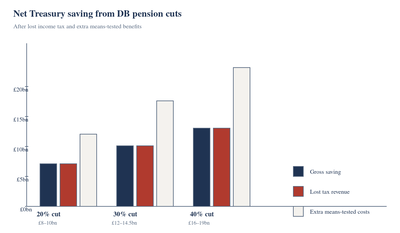
A 40% cut to unfunded public-sector pensions would save £16-19bn annually after accounting for lost tax revenue and increased welfare spending, not the £24bn often claimed.
Bringing DB pensions in line with DC pensions requires realistic analysis, not a blanket percentage cut
A government proposal to cut defined benefit pensions by 40% lacks sound comparison with defined contribution pensions, which offer less certainty and different risk profiles.
Estimated Treasury saving from a 40% cut in DB pensions
A 40% reduction in public-sector defined-benefit pensions could save around £19-21 billion annually after accounting for lost income tax, though actual savings would depend on means-tested support and legal challenges.
Comparing defined benefit and defined contribution pensions: which provides better retirement income?
Defined benefit pensions offer guaranteed income but are rare outside the public sector. Defined contribution pensions require workers to manage investment risk, but aggressive investing and delayed retirement can match DB outcomes.
Understanding the UK's two-tier pension system: Defined Benefit versus Defined Contribution
The UK pension system splits between Defined Benefit pensions, offering guaranteed income mostly to public sector workers, and Defined Contribution pensions, where private sector workers bear investment risk.
How UK pension funds were caught up in the 2008 Icelandic banking collapse
UK pension funds lost significant sums when Icelandic banks collapsed in 2008. Some recovered losses through settlements, whilst others faced prolonged disputes with the Icelandic government.
UK pension funds are dispersed across diverse investments including equities, bonds, real estate, infrastructure and private equity, managed by professional asset managers across global financial markets.