In the UK: the 1979-1990 period
· Updated · No. 208
The government sold state-owned businesses to raise revenue and reduce state involvement in industry. Whilst privatisation brought substantial one-off money, the relationship between these sales and national debt reduction was more complex than a simple transaction.
When Margaret Thatcher became Prime Minister in May 1979, the UK was facing economic difficulties, including high inflation, industrial unrest, unemployment and pressure on public finances.
To understand why the government began selling state-owned businesses, it helps to look at the national debt, government borrowing and the purpose of privatisation.
What was the national debt like in 1979?
The UK entered the 1980s with a substantial national debt, although it was not at a historic peak.
The House of Lords Library, using official figures, reports the following:
| Financial year | Public sector net debt (% of GDP) | Government borrowing (% of GDP) |
|---|---|---|
| 1975-76 | 49.3% | 6.3% |
| 1978-79 | 42.2% | 4.5% |
| 1979-80 | 39.1% | 3.7% |
The debt-to-GDP ratio had fallen from its mid-1970s peak by the time Thatcher took office. However, the government was still borrowing more than it collected in revenue.
The distinction matters:
National debt is the accumulated amount the government owes.
Government borrowing is the additional amount it needs to finance a deficit in a particular year.
Why did the government sell state-owned businesses?
Privatisation means transferring ownership of a business or industry from the public sector to private owners.
Before the 1980s, the state owned major businesses in industries such as telecommunications, energy, steel, aviation and water.
The Thatcher government pursued privatisation for several reasons:
Raise money: Selling state-owned assets brought money into the Treasury.
Reduce the state's role in industry: The government wanted private companies to take responsibility for running businesses.
Encourage private investment and competition: Supporters argued that private ownership could improve efficiency and service.
Reduce the need for public funding: The government wanted to reduce its financial exposure to state-owned businesses.
The policy developed over time, combining the immediate objective of raising revenue with a wider commitment to changing the relationship between government and industry.
How much money did privatisation raise?
The sales generated substantial revenue.
By October 1989, the government reported that net proceeds from privatisation since May 1979 amounted to approximately £27.5 billion.
By March 1996, the reported total had reached £81 billion in 1995-96 prices.
The money could be used to help reduce borrowing and public debt, or to support the government's wider financial position.
But there is an important distinction:
Selling a business brings in money once. It does not automatically reduce the government's ongoing spending or create a permanent source of income.
The government also gives up ownership of the business and its future profits.
Did privatisation reduce national debt?
It helped the government's finances, but the relationship is more complicated than simply selling businesses and eliminating debt.
Privatisation receipts reduced the government's reported borrowing requirement. However, the government was also affected by economic growth, taxation, public spending, unemployment and other factors.
For example, a parliamentary table shows that privatisation receipts were equivalent to 1.5% of GDP in 1988-89, while the public sector borrowing requirement was negative 3.1% of GDP that year, indicating a financial surplus under that measure.
That does not mean privatisation alone produced the surplus.
What happened when the water industry was privatised?
In 1989, the water and sewerage industry in England and Wales was transferred from public ownership to private companies.
The government argued that private ownership would help finance improvements to infrastructure and meet environmental requirements.
The sale also generated money for the Treasury.
But the change had a lasting consequence: customers would now pay private companies for water supply and wastewater services, with prices regulated by a public regulator.
The companies became responsible for operating and maintaining the infrastructure, while customers continued to fund the service through their bills.
The key financial trade-off
The debate over privatisation is partly about the difference between a short-term financial gain and the long-term consequences of transferring ownership.
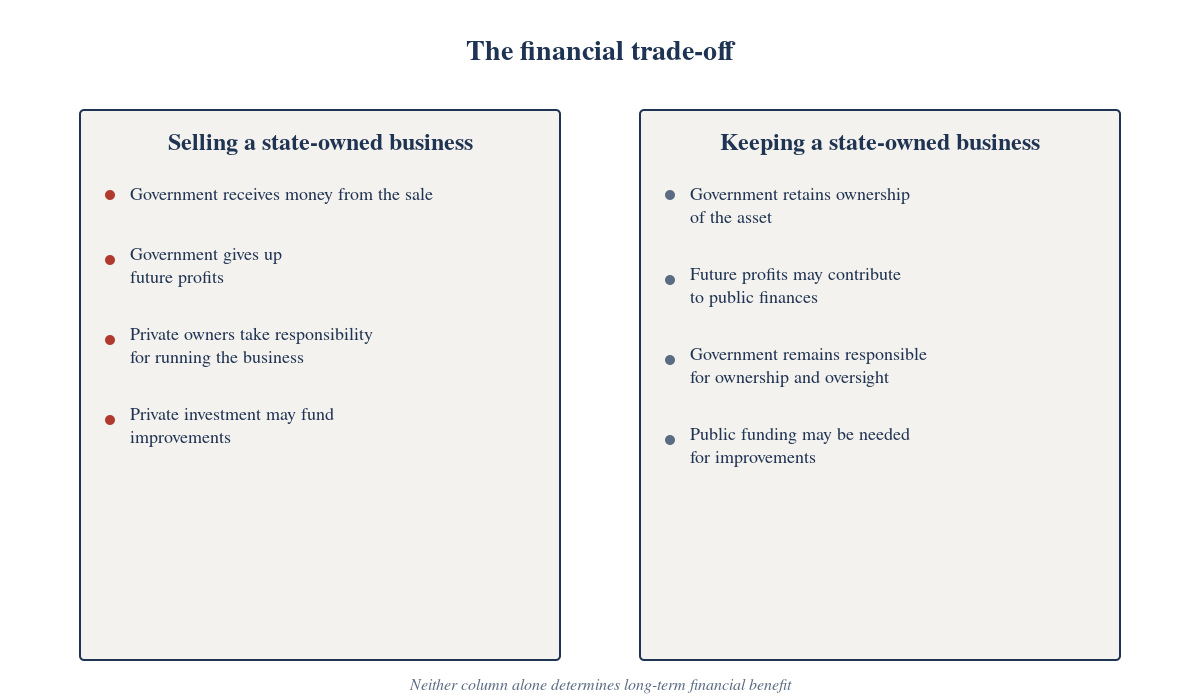
| Selling a state-owned business | Keeping a state-owned business |
|---|---|
| Government receives money from the sale. | Government retains ownership of the asset. |
| Government gives up future profits. | Future profits may contribute to public finances. |
| Private owners take responsibility for running the business. | Government remains responsible for ownership and oversight. |
| Private investment may fund improvements. | Public funding may be needed for improvements. |
Neither column, by itself, tells us whether a particular sale was financially beneficial over the long term. That depends on the sale price, the business's future performance, investment needs and the arrangements for regulation.
In summary
The Thatcher government inherited a difficult economic situation and used privatisation to raise revenue, reduce the state's direct involvement in industry and change how major businesses were run.
Privatisation brought in substantial one-off sums, but it did not mean that national debt disappeared. It also transferred ownership of assets and their future income streams from the public to private shareholders.

Comments
No answered comments yet. Yours could be the first.
Add a comment
Your email address is needed so we can reply, and is never shown on the site. Comments appear here once they have been answered.